

The privilege of innocence
How can I celebrate Father's Day while ICE is destroying families across our city?

My plan was to share sweet vignettes about our first camping adventure and how stoked I am that you still don’t know what a CoComelon is. But in times like these, fixating on the everyday feels like a form of escapism. How can I write about coaxing you to eat your vegetables when they’re picking off the farmers in broad daylight? How can I reflect on negotiating your screen time when I’m doomscrolling videos of a mother of six being thrown into a van to nowhere? For the past three years, I’ve been telling people that being a father is about learning to be in the moment. I’m realizing that it’s also about showing you how to be in it too. Even dark moments like this one.
We visited your grandparents in Filipinotown last week. As they offered you baby bananas and sugared crackers, KTLA blared in the background with reports of ICE raids at the Home Depot down the street and the clashes between the National Guard and protesters. When they started showing footage of a reporter getting shot by a rubber bullet, I threw my palm over your eyes and asked your Lolo to change the channel. “He isn’t ready to see this yet,” I blurted out, as if there’s a point when looming martial law becomes age-appropriate. The truth is, I wasn’t ready to explain it to you. I wasn’t ready to see a part of your innocence die.
As a kid, I used to hate when my parents did this. Back then I wondered, what makes me so different that I’m not allowed to witness what everyone else can? As I found myself repeating history with my own child, I felt what my parents must’ve – like I was tossing a glass of water at a wildfire. To raise a young child is to be in a constant battle over whether to expose you to this world or to shelter you from it.
You’ve been asking a lot of questions lately – a window to how your view of your surroundings is rapidly becoming more complex. Why are these flowers red, and those flowers purple? How does that squirrel run up the tree like that?
These are the easy questions, at least compared to the ones you’ve been asking the past few days: Why are there so many sirens? Why is that policeman pushing people? Why is mommy crying?
I, like many parents, have been guilty of lying in order to preserve your innocence. The lie is usually not very sophisticated – I’ll say something like “I don’t know…” and drift off like I’m investigating in my mind when really I’m hoping you’ll get distracted by a random sound and forget. Maybe my lie is more of a half-truth – I often do know the answer, I just don’t know how to frame it in a way that doesn’t erode your impression of the universe as the welcoming, wondrous, loving place that I’ve spent your toddlerhood curating.
A child’s “innocence” is often defined by a shielding from the harsher, more vicious contours of life and society; to be innocent is to be in a state of unfettered belief that no harm is ever coming to you and your loved ones; to be innocent is to be in a blissful bubble. But when does innocence become obliviousness? Which birthday marks the turning point when you are no longer innocent, but complicit?
And what about the other kids your age who have seen things nobody could block their eyes from? Those who have watched their parents vanish and their homes get ransacked, who have experienced the inside of a cage – are they no longer innocent? What, then, are they guilty of? I spent your early childhood sanitizing everything around you – your toys, your furniture, your baby bottles. But now you are encountering the kinds of toxic things in this world that I can’t cleanse for you, as much as I yearn to.
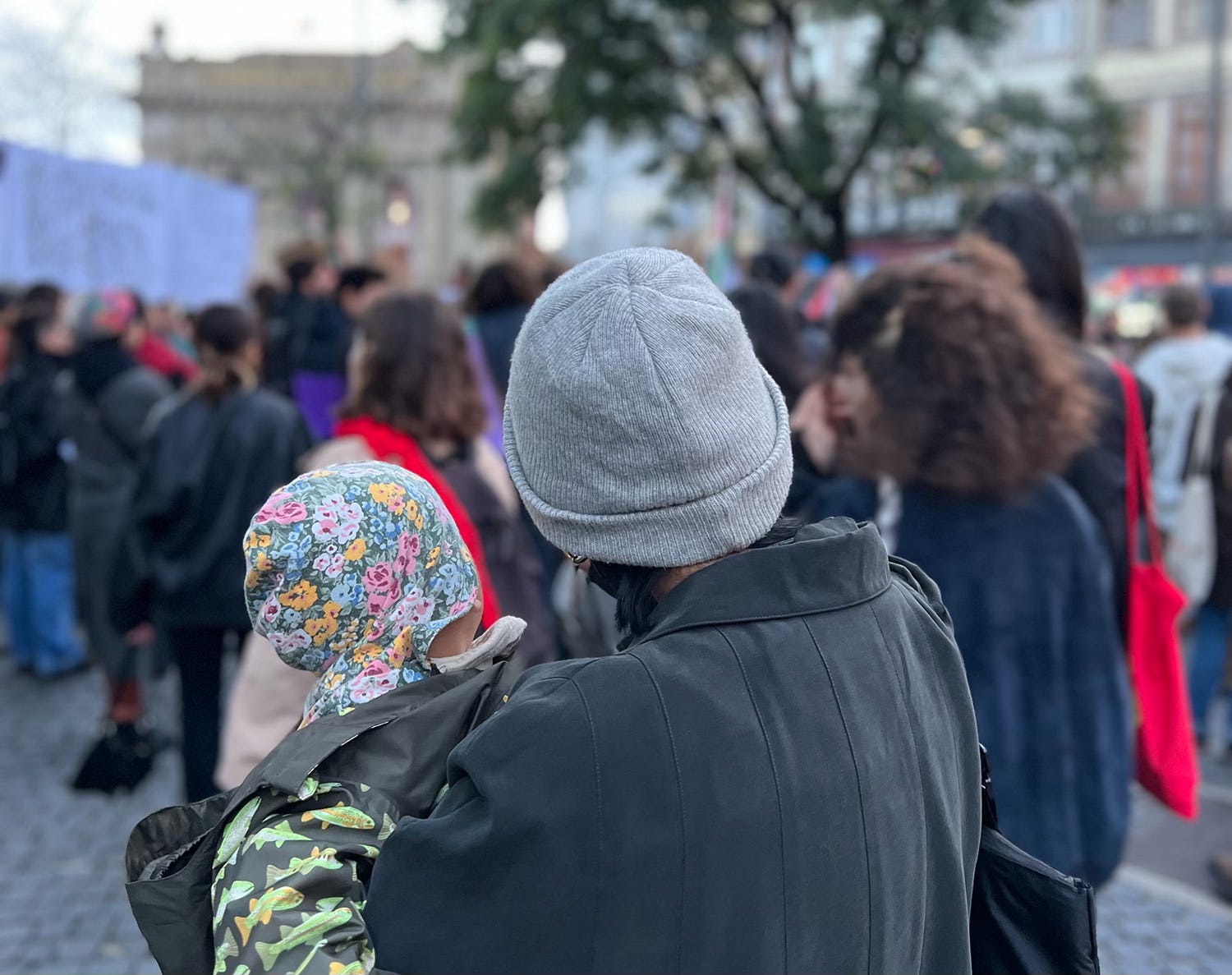
The first time we took you to a demonstration, it was in October 2023 when you were barely walking and I could count your words on my fingers. We were on a family vacation in Porto when bombs began falling on Gaza. In a foreign town square half a world away from home, speakers spoke and hecklers heckled in languages we didn’t understand, but felt we needed to hear. We made sure you were snug in your mom’s wrap while I looked around for shady characters and alleyways we could run through in case shit went down. Later, we pointed to Palestine on a globe. We let you hear voice memos from our friends who were getting ready to move out of the West Bank, the only place their kids had ever known. We held you tight.
This past week, after some deliberation, your mom and I decided it was time to take you to another demonstration. But this time, you weren’t a baby staring blankly from a wrap. You can now locate LA on a map, can sense when the energy in a room is tense, and understand the power of the word no. “We’re going to support some kids whose mommies and daddies aren’t allowed to go home,” I explained, feeling like my years in ethnic studies and grassroots organizing had completely turned to goo in my mouth. You curved your eyebrows in a look of determination you learned from your favorite cartoon, grabbed your Totoro bag full of toy tools, and shouted, “They need our help…let’s roll!”
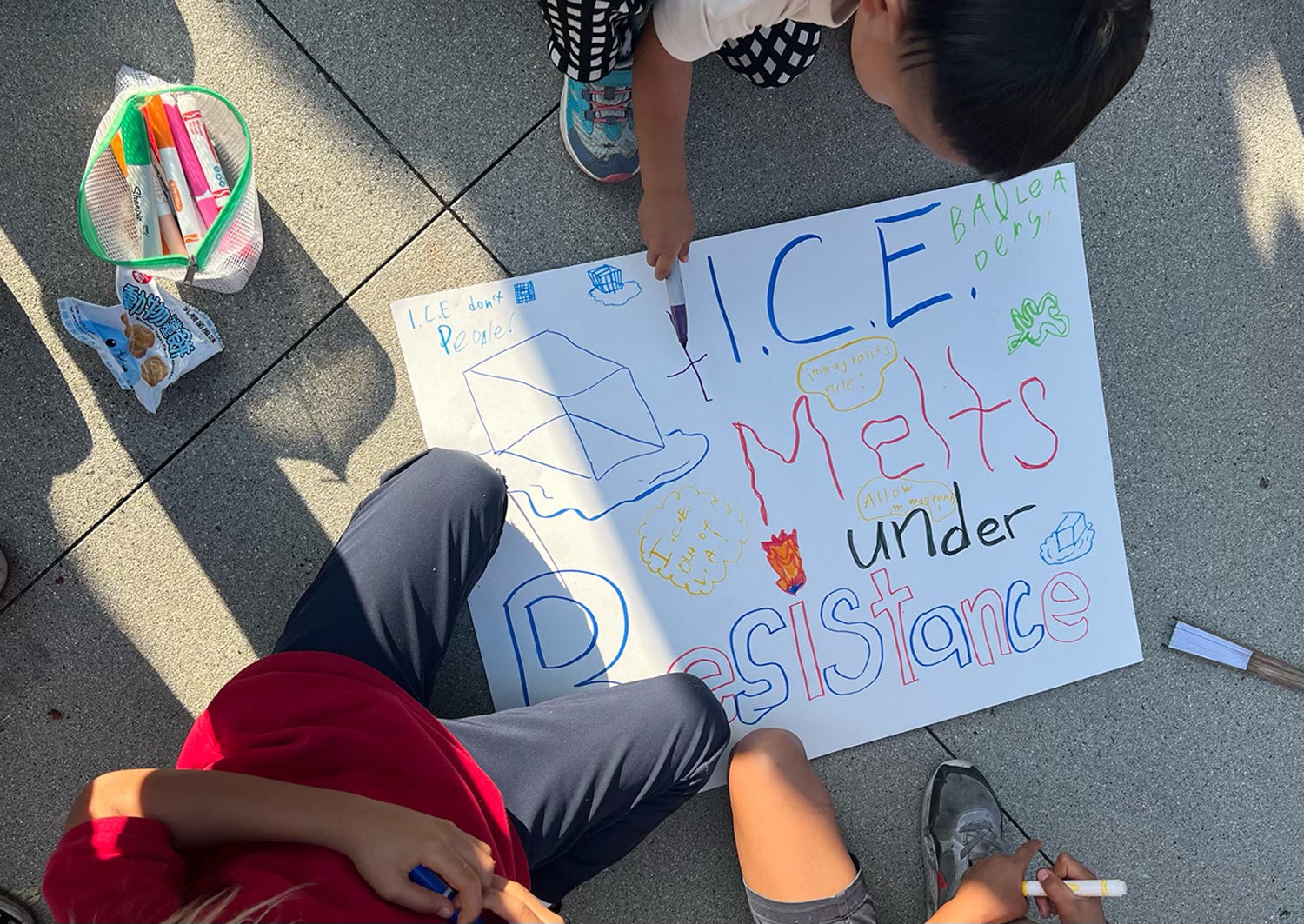
Some might argue that this is the kind of experience that threatens a toddler’s innocence. We live in a time of cognitive dissonance, where parents are expected to enroll their two-year-olds in a Spanish immersion program, but God forbid you talk to them about America’s obsession with building walls to shut out the rest of world. It’s not like we expect you to understand geopolitics or immigration law, but we know you understand separation anxiety and what it means to badly want to go home. You may look back at that experience as just another playdate where we met up with friends, took a walk to the city center, and made signs with markers. But we know one day you will learn about this history – the people who suffered, those who tried to do something about it, and those who let it happen while hiding behind their disclaimers. When you ask us whether we showed up for the moment, we will assure you that we did.
Todays’ question for the people:
What are effective ways you’ve introduced young people to complex social topics?
Dear friend, ahé’hee for sharing. I feel these parental reflections soul deep. Our framing for much of these times has been through the lens of body autonomy but in kid language- and using the boarding school era as a springboard since they are very aware of this (shoutout to Molly of Denali for her heavy lifting!) Then we make connections to family separation. I’m not sure how much is landing but I know they have lots of questions.
I feel so often that I fall short of what and when and how to hold it all personally as a mom and struggle to still weave together the kiddos’ understanding as well. Your words are a reminder that this is the path and I am not alone.
“To raise a young child is to be in a constant battle over whether to expose you to this world or to shelter you from it. “