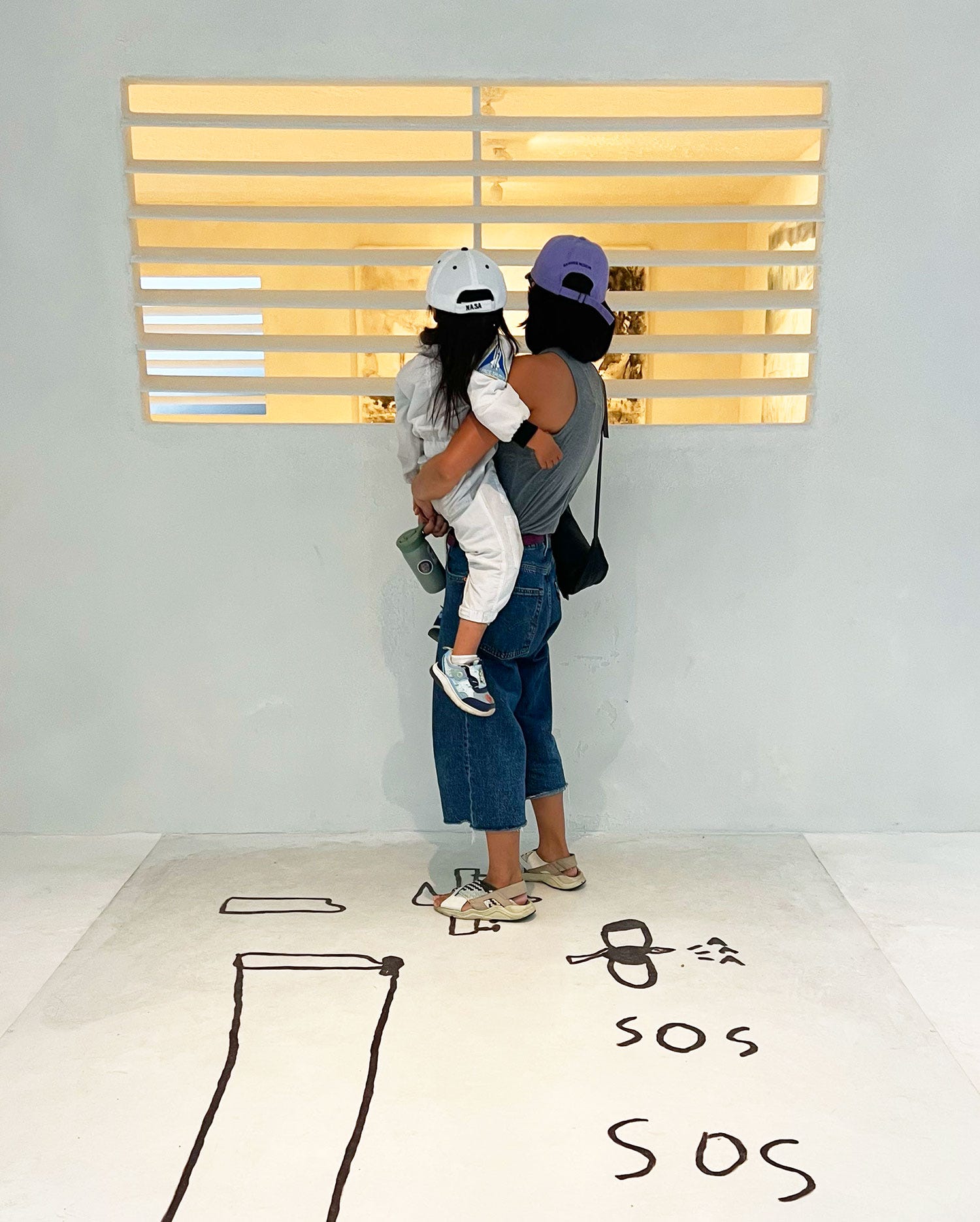
Mothership Connection
When finding wholeness means breaking away.

For decades, psychologists have explored a theory that the child spends its first stage of life believing itself in unison with its mother. They are enmeshed, in a merged state, a single organism. For a baby, the notion of a self is as unknowable as deep space and distant time: me is the same as we, and we are only here, now. Being with mom is not about seeking comfort or safety, it’s about finding identity.
Hold this theory, and know that the moment of birth is not an awakening, but a rupture. Imagine prying the swirled color out of a marble and calling it whole. Imagine tearing a strip of velcro from its other half and telling it that this is where life truly begins.
The theory is known as “object relations,” where the “object” is the mother (which is how you know the phrase was coined by a dude). Freud described the mother as the primary source from which man draws his drive – which evokes less of an image of an infant wrapped in maternal embrace, and more of a Roomba plugged into its charger. Two generations later, the pediatrician Donald Winnicott challenged Freud by attempting to afford the mother some agency. Rather than a fixed platform whose energy is to be siphoned, she’s a dynamic being whose every move reflects the child’s development toward the person it will become. She’s not a charger, he argues, she’s a mirror.
Winnicott is responsible for the term “good enough mother” – a woman who, despite her will for perfection, should rest assured that she’ll ultimately fail. In fact, the child’s sense of self depends on that failure: each time she doesn’t offer milk right when it’s called for, each time she doesn’t rush in immediately at the sound of a wail, each time she falls short of any expectation – is a necessary moment where the child must build their independence. The mirror cracks bit by bit, revealing a new self, ready to leave the broken pieces behind. Winnicott, like other patriarchs in his field, framed his mansplanation of motherhood to come across as a soft caress, but it lands like a slap in the face. He literally calls this process the child’s “disillusionment,” which his wives must have found so encouraging, if only they ever had children.
Today, the “good enough mother” is widely accepted and embraced in child development circles, and is packaged as an antidote to the pressures of our culture of hyper-vigilance and helicopter-parenting. Acknowledging that “good enough” is not only satisfactory, but preferred to perfectionism, is meant to release mothers from feeling like they have to parent like a master bonsai gardener.
But who decides how good is good enough? Just pray for the best, and let God be the judge. Or your child one day. Or the internet.
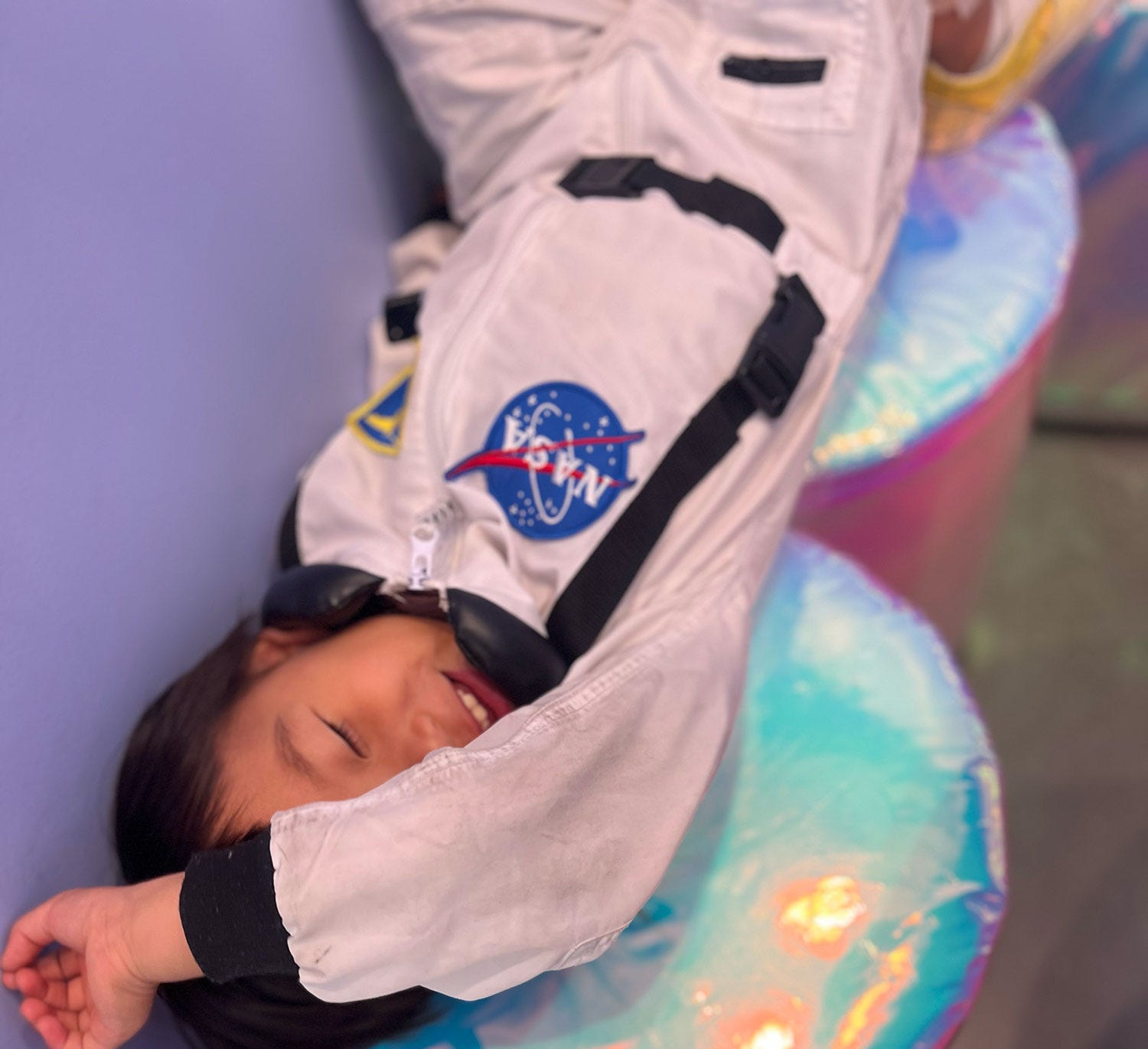
You’ve spent the past four months dressed as an astronaut. It started way before all the Artemis II hype, but beginning in April, more and more random adults started stopping you in the streets to compliment your outfit. I smile back at them the way a polite parent is supposed to, while clocking your grimace and eye-roll. They assume that since you’re only three, you don’t realize how patronizing the entire exchange is – how they widen their eyes, raise their voice a few notches, lean in closer than anyone is supposed to in our post-pandemic world. “DID YOU JUST COME BACK FROM THE MOON????” The question is always followed by laughter that ranges from a soft chuckle to a straight up cackle, like a clown clawing into your imaginary world.
“NO!” you sometimes shout back, furrowing your brows and turning away.
“Excuuuuse me!” they’ll often respond, defensively throwing their hands up. “I guess we’re anti-social today [insert another soft chuckle and/or clown cackle].” This happens so regularly, it makes sense why you’ve steadily become more self-conscious in that outfit. Some might even call it disillusionment.
You eventually started wearing your space suit almost exclusively at home, away from the gaze of commenting strangers. Your mom seized the moment to teach you about the cosmos: the difference between comets and asteroids, that the sun is a star we revolve around, and why we see the moon in different phases. Together, the two of you draw celestial bodies on paper as backdrops for puppet shows about space missions. You’ve become the only person I’ve ever met whose favorite planet is Uranus. “It’s because it’s so cold, and remember, I like the cold!” you say, reminding us why you refuse to wear jackets. You recall that Mom’s favorite planet is Jupiter because it has many moons, and Dad’s favorite planet is Venus, because he is a performative male.
The day the Artemis II launched, Mom sat you on her lap in front of the computer for the countdown. Mom and I held our breaths as it began taking off – as all of us who were born in the wake of the Challenger explosion do – and sighed with relief as it blasted out of the stratosphere. But when the rocket began shedding its boosters, you shouted, “Oh no, it’s breaking!”
“Don’t worry, that’s how it’s supposed to happen,” comforted Mom. “The capsule can’t take those parts with it, it has to go on its own.”
“What happens to the other parts?” you asked.
“They just…break away,” she responded.

Even before your space phase, Mom has said half-jokingly that she’ll support you becoming anything other than a football player or an astronaut: football because of the concussions, astronaut because of that whole thing about leaving the planet. “But you’ll come with me,” you insist, holding her close. Some nights, watching you asleep in your space suit, Mom’s imagination leads her to legit tears as she pictures you waving goodbye from a shuttle headed to Uranus. I’ll be too old to go with you, she laments. It’ll be so cold there. Will you bring a jacket?
Luckily for us, you won’t even let us drop you off at daycare without screaming until you’re snot-nosed. We’ve got some years before we need to worry about interplanetary separation. You’ve even told Mom that you wish you could crawl back into her belly, which you express in the baby-voice you assume whenever we make any mention of what it means for you to be growing up.
I can only imagine how hard it is to begin grasping your sense of self while learning that you are just a speck in an infinitely expanding universe. To discover that you are like a space ship, that the pieces that are core to your being must eventually break away, and that the first part you shed is your mother. To know that this is all necessary in order for you to get a better view of the world, with your parents watching from a distance, hoping it’s a good enough place to return to.