

In the feels
Some things cannot be named.

Since the day you began uttering words, your mom and I have been encouraging you to name your feelings. We gaze into your face like a cloud formation, constantly asking you questions that sound like they came from an old “What emoji are you?” Buzzfeed quiz.
“Are you…sad?” we’ll ask as your brows turn red, tears dribbling down your cheeks like an over-boiled pot. “Yesssssssss…” you’ll sob, your mouth the shape of a bent pipe.
“Are you…excited?” we’ll ask as you zigzag the playground like a tasmanian devil. “Yes! Yes! Yes!” you’ll shriek, drunk with adrenaline and sweat.
“Are you…mad?” we’ll ask as you stomp around the kitchen after your request for cake for breakfast is denied. “YEAH!” you’ll bellow, teetering on the verge of a tantrum.
My generation was raised by elder generations that were largely incapable and unwilling to discuss their feelings – especially with their children. Emotions had no place in the public – and in the private, well, that’s where you practiced behaving in the public. During my coming-of-age in the early 2000s, Dave Chappelle warned me about the consequences of keeping it too real.
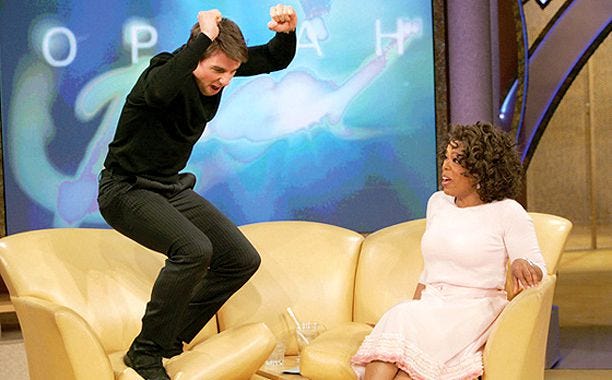
During the first election I was old enough to vote, I witnessed Howard Dean’s presidential campaign go up in flames because he got excited and shrieked too loudly. Tom Cruise has spent his career leaping from canyons and helicopters, but everyone described him as the crazy guy who jumped on a couch because of love. The message was clear: Glee is unprofessional. Sorrow is unbecoming. Rage is punishable.
Now, it seems the pendulum has swung in the opposite direction. The mental health crisis among today’s youth has awakened everyone to the fact that bottling it up is actually not a great life skill. Emotional intelligence has been airdropped into the education system, taught alongside numbers and the alphabet. Now, all feelings are welcome, and they appear in the test as a multiple choice question.
But unlike digits of which there are ten, or letters of which there are 26, emotions come in multitudes. Emotions are complicated, and they are personal. The letter R is the same no matter who reads it, but happiness is different depending on who feels it. I watched with discomfort as you played a Sesame Street game that kept buzzing “ERRRR” whenever you poked at a muppet’s facial expression that didn’t match the word. “Hmm…he doesn’t seem happy…try again!” Elmo purred at you. But how do you learn about the feelings you can’t just put a finger on?
Now that I’ve cultivated the habit of sportscasting your emotions, I’m beginning to wonder if this was the wrong move all along. Some feelings can’t be identified immediately, and aren’t supposed to be. Some sit in the belly, collect in the shoulders, swirl in the mind before materializing on the face. Some lurk deep inside, subtly influencing our moods and actions in stealth mode. Maybe the problem isn’t that we don’t know how to name our feelings, but we don’t know how to feel them in the first place.
I should know all this. I fell in love with writing as a practice of excavating emotions that do not fit plainly into a singular word – emotions that must be processed through line breaks and metaphors in order to find some kind of tangible shape. I’ve spent many gloomy mornings paralyzed under my sheets, sorting through my vocabulary bank to diagnose my inexplicably heavy heart, and finding no words that suffice. I should understand that this early period of life before language is sacred. Your emotions are in the rawest state they will ever be – without their designated labels and the social contracts that police them.
Many of us like to believe that we subscribe to an “all emotions are healthy” philosophy, meanwhile retreating into our phones to gawk at the latest person who went viral for being cringe or unhinged. We debate about the role of empathy in our society – to what extent it belongs in politics, in the workplace, in how we raise our children. But how can we possibly begin to assume attunement with someone else’s emotions when we can’t even face our own?
Earlier this week, mom went to the hospital because of chest pains. “I’ll be back in a bit!” she chirped before heading out, as if she were just going to the store for milk. Throughout the afternoon, she was referred to different offices, nurses, and doctors, suspended in a clinical limbo of “probably fine, unless it’s serious.” I took you to the playground to keep you distracted, and if I’m being honest, to distract myself too. I sat with you, shoveling sand into buckets for sandcastles, trying to immerse myself in positive imaginary scenarios as opposed to grim ones. When we got home, you checked all the rooms and came back a little paler. “I want mommy to come back from the hospital now,” you whimpered. I shepherded you through your evening routines, suggesting that she might be back by the time we finish cleaning up your toys, then after your bath, then after dinner.
It turned dark outside, and mom still wasn’t home. A doctor suggested a CT scan, and maybe an overnight stay. I asked you to put your shoes on. “We’re going to visit mommy!” I squealed with unnecessary exuberance. Your slumped body was heavier than normal as I carried you to the waiting room. You usually get excited by the sight of ambulances, but as we walked by them you just stared at them. Mom and I greeted each other with voices pitched higher than normal. You stayed silent.
“Are you…worried?” she asked. You buried your head into my shoulder, only raising it to glance periodically at the nurses carting patients around in their stretchers. You were feeling something, too enveloped in it to respond. After awhile, we kissed mom goodbye and headed back to the car. You sulked softly as we crossed the street and I settled you back into the carseat.
“Can you put on a song and sit with me?” you asked – the first words you’d said since leaving the hospital. You looked out the window to let the moonlight reflect on your watery eyes. We stayed in the backseat and played slow jams until you nodded off, your mouth petrified in a frown.
I sat in the parking spot until mom was finally discharged a little past midnight. It turned out she did not have a disease or an ailment, but an overpowering swelling of anxiety from the state of life and the world. A false alarm, an early warning, and a sign of the times. The doctor advised she manage her stress and get more sleep, as if things said are just as easily done. “How are you feeling?” I asked, by reflex. We drove home quietly.
As I tucked you into bed, I wondered if a core memory had just been formed. I reflected on how I sometimes ask you to hold the things I haven’t myself grasped. About how much of growing up requires us to withstand moments of concern and uncertainty – to sit with the kinds of emotions that can consume us. I thought about how, when a thing is consuming me, the last thing on my mind is what to name it.
As always, beautifully written. This line really struck me somehow, "The letter R is the same no matter who reads it, but happiness is different depending on who feels it."